
High-frequency spinal cord stimulation
A therapy for chronic pain.
When pain is invisible, but real.
Chronic pain is a condition characterised by persistent suffering (lasting more than six months), which profoundly affects daily life, making even the simplest activities such as walking or sleeping peacefully difficult.
Chronic pain manifests itself through a combination of symptoms that may vary from person to person. Among the most common are an intense, stinging pain, often accompanied by a burning sensation or persistent muscle discomfort. Numbness, hypersensitivity to touch, skin changes and swelling, which may also be accompanied by a general feeling of weakness. These often overlapping symptoms contribute to rendering chronic pain a debilitating condition that goes far beyond mere physical pain.
What is high-frequency spinal cord stimulation?
High-frequency spinal cord stimulation (SCS) technology uses electrical pulses to modulate the nerve signals responsible for pain perception. The therapy consists of transmitting electrical pulses to the spinal cord through electrodes, consisting of thin flexible electro-catheters positioned close to the spinal cord, which transmit these pulses to the nervous system, modifying pain signals before they reach the brain, thus helping to reduce pain perception.. These pulses are generated by a small device (similar to a pacemaker), implanted subcutaneously..
These systems use both low and high frequencies, which can be combined with a variety of wave modulations: by using some of these combinations, it is also possible to avoid the occurrence of paresthesias (a side effect that manifests itself through tingling or uncomfortable sensations).
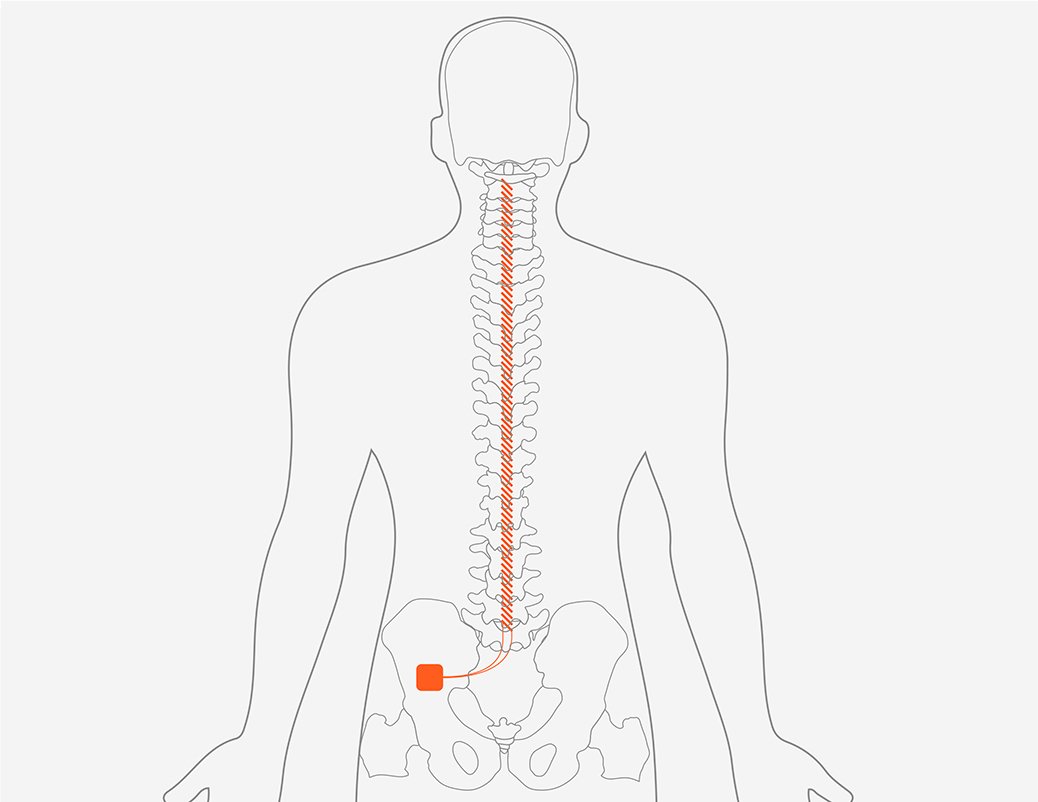
The potential benefits of spinal cord neuro-stimulation
1
Effective and long-lasting relief from chronic pain.
2
Reduction of drug therapy.
3
Improved quality of life, thanks to decreased disability, improved functionality and more restful sleep.
4
Customisable treatment thanks to variable settings, offering tailor-made therapy, constantly adapted to individual needs.
5
Minimally invasive technique, which involves implanting a small device subcutaneously.

Who is this type of treatment suitable for?
This depends on the type of medical device although, as a rule, these types of technologies are used for patients affected by chronic nerve pain and other forms of drug therapy-resistant pain, such as:
- Peripheral nerve pain
- Failed Back Surgery Syndrome (FBSS)
- Chronic radicular and lumbar pain
- Post-traumatic and post-operative pain
- Failed Back Surgery Syndrome (FBSS)
- Therapy-resistant lumbago
- Back, lower limb, upper limb and neck pain.
- Painful diabetic neuropathy and non-surgical refractory back pain
Painful Diabetic Neuropathy (PND)
Among the most complex chronic pain conditions to manage, painful diabetic neuropathy represents a significant challenge. Clinical studies confirm that high-frequency spinal cord stimulation is capable of:
- Reducing pain substantially in patients with medication-resistant PND
- Improving neurological function and quality of life
- Decreasing the use of analgesics
- Improving glycometabolic control

Customer testimonials*
Stimolazione midollo spinale 2 ENG
"[...] and then I felt no more pain. That day was so emotional, I felt nothing. When you get out of bed and start to walk without feeling any pain, nothing beats that feeling."
Stimolazione midollo spinale 1 ENG
"It changed everything and gave me a new lease of life”
*Talk to a pain therapist
Before making a therapeutic choice - and the neuro-modulative field is no exception to this rule - patients should always consult a specialist so as to consciously assess the benefits, possible risks and the most suitable course of action for their individual needs.
Sources
Kapural et al. Comparison of 10-kHz High-Frequency and Traditional Low-Frequency Spinal Cord Stimulation for the Treatment of Chronic Back and Leg Pain: 24-Month Results From a Multicenter, Randomized, Controlled Pivotal Trial. Neurosurgery. 2016 Nov;79(5):667-677
Stauss et al. A multicenter real-world review of 10 kHz SCS outcomes for treatment of chronic trunk and/or limb pain. Ann Clin Transl Neurol. 2019 Jan 22;6(3):496-507.
Hoelzer BC, Edgar D, Lu SP, Taylor RS. Indirect Comparison of 10 kHz Spinal Cord Stimulation (SCS) versus Traditional Low-Frequency SCS for the Treatment of Painful Diabetic
Neuropathy: A Systematic Review of Randomized Controlled Trials. Biomedicines. 2022 Oct 19;10(10):2630. doi: 10.3390/biomedicines10102630. PMID: 36289892; PMCID: PMC9599433.
Stauss et al. A multicenter real-world review of 10 kHz SCS outcomes for treatment of chronic trunk and/or limb pain. Ann Clin Transl Neurol. 2019 Jan 22;6(3):496-507.
Amirdelfan et al. Long-term quality of life improvement for chronic intractable back and leg pain patients using spinal cord stimulation: 12-month results from the SENZA-RCT. Qual Life Res. 2018 Aug;27(8):2035-2044.
Petersen et al. Long-term efficacy of high-frequency (10 kHz) spinal cord stimulation for the treatment of painful diabetic neuropathy: 24-Month results of a randomized controlled trial. Diabetes Res Clin Pract. 2023 Sep;203:110865.
Petersen et al. Long-term efficacy of 10 kHz spinal cord stimulation in managing painful diabetic neuropathy: A post-study survey. Pain Pract. 2025 Jun;25(5):e70023.